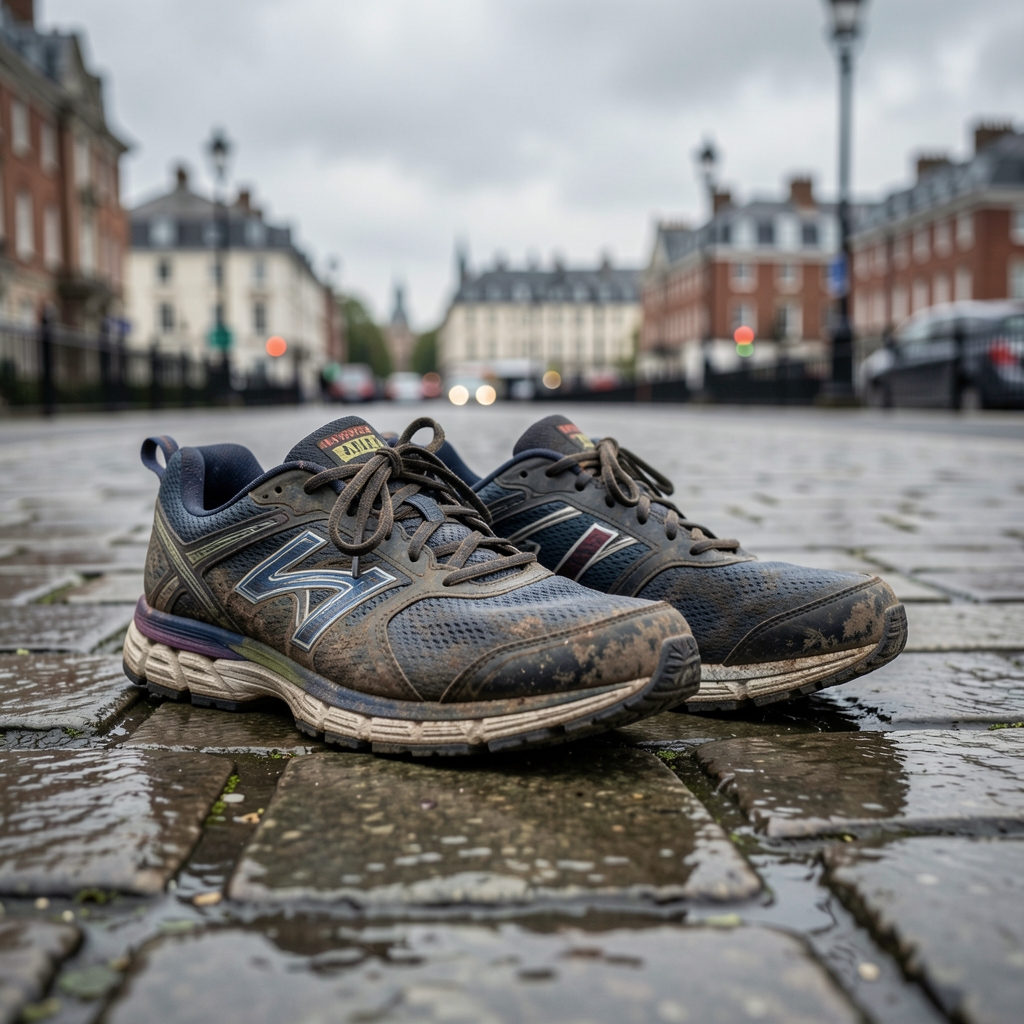
The question was simple. Over seven weeks, I would add a daily walk of at least thirty minutes to my existing routine — nothing ambitious, nothing that required particular equipment or commitment beyond the decision itself — and I would keep a food journal throughout. The journal was not kept to record the walk. It was kept to record what I ate. It was only in reading the entries back that the walk appeared in them at all, and in a form I had not expected.
The Setup and What Was Recorded
The walks took place in the early morning, before the working day began. The route varied but always began from the same point — the corner of Lever Street and Old Street in Clerkenwell — and always lasted between thirty and forty-five minutes. There was no pace requirement. The criterion was simply continued movement for the full duration.
The food journal used was a small, ruled notebook of the kind sold in any stationery shop. Each entry recorded the meal, the time at which it was eaten, the rough context (desk, table, standing in the kitchen), and a brief note on appetite before and after eating. The appetite notes were not rated on any scale; they were written as short descriptions, in whatever language felt appropriate at the moment of writing. On some days those descriptions were single words. On others they were several sentences.
I had kept food journals before, in various forms, over the course of a professional life largely concerned with nutrition. This was not the first or the most rigorous. It was, however, the one whose findings surprised me most.
What the Appetite Entries Said
By week two, a pattern had appeared in the pre-meal appetite notes that I had not observed in previous journals. On days when the morning walk had taken place, the pre-lunch appetite entry tended to use language of specificity: "ready for something warm," "would like vegetables," "thinking about the soup from yesterday." On days when I had skipped the walk — which happened on six occasions across the seven weeks, typically due to rain or an early meeting — the pre-lunch entry tended toward vaguer language: "hungry," "tired," "could eat almost anything."
The distinction between specific appetite and vague appetite is not a category I had encountered in the nutritional literature I had read, though something close to it appears in the phenomenological food writing of certain researchers working on eating behaviour and bodily awareness. But the distinction was legible in the notebook without any framework to interpret it. Specific appetite and vague appetite produced different meals. The former tended to produce meals that were composed — a conscious selection of particular foods assembled in a particular way. The latter tended to produce meals that were found — whatever was available, whatever required least decision-making, whatever was near.
This is a significant distinction from the perspective of weight awareness. The composed meal and the found meal are not always nutritionally different in any dramatic sense. But they are eaten differently. The composed meal is eaten with some residual intention; the found meal is eaten without it. And meals eaten without intention — the evidence of the journal and the wider literature — tend to be eaten faster, past a clearer point of sufficiency, and with less subsequent satisfaction.

The Walk and the Meal: A Proposed Mechanism
I am cautious about causal claims from a single-person observation record, and a qualified caution is appropriate here. But the pattern was consistent enough to suggest a hypothesis worth recording. Walking, as a form of sustained, low-intensity physical activity, may function as a kind of bodily attunement — a period in which the body's signals become more legible to the person inhabiting it.
This is not the conventional account of exercise and appetite, which tends to focus on caloric expenditure and the suppression or stimulation of hunger hormones. Thirty minutes of moderate walking does not meaningfully alter caloric balance in a way that would explain the differences I observed. The change was not in quantity. It was in the quality of attention brought to food in the hours that followed.
A morning walk of thirty to forty-five minutes involves a period of continuous physical sensation: the rhythm of walking, the experience of temperature, the observation of the immediate environment. These sensations have a quality that is quite different from the primarily cognitive experience of desk work or screen use. They are of the body and located in time. By the end of the walk, there is a clarity — of mood, of sensation, of readiness — that the days without the walk did not produce.
It may be that this clarity carries over into the experience of appetite. A body that has been recently attended to — that has moved and been present in its movement — may communicate its signals more clearly. Hunger, when it arrives at mid-morning, feels more specific: not a general restlessness but a particular readiness for a particular kind of food. That specificity may be the mechanism. It is not that the walk changes what one eats; it changes the quality of listening with which one hears what one wants to eat.
"Walking does not make the appetite louder. It makes the listener quieter — and from that quiet, a more honest reading of what the body wants becomes available."
What Changed in the Evening Entries
The morning observation was the most consistent finding. But the evening entries also shifted across the seven weeks, in a way that suggested the walk's influence extended beyond breakfast and lunch.
In weeks one and two of the observation — before the pattern of the walk had fully established itself as routine — the evening meal entries were often the most cursory of the day. "Dinner, late. Pasta, I think." "Soup, standing up, didn't record time." By week four, the evening entries had lengthened. Not dramatically, but enough to notice: "Roasted cauliflower with lentils and lemon. Ate at the table. Not hungry before, moderate hunger after, satisfied by 8pm." The attention that the morning walk seemed to produce in the appetite did not disappear by dinner; it accumulated across the day.
I want to be precise about what this suggests. It does not suggest that walking produces better meals. It suggests that walking, at least in this record, produced better conditions for the kind of attention that makes a meal more fully a meal. The walk did not change what was in the refrigerator. It changed something in the relationship between the person standing in front of the refrigerator and the food it contained.
Practical Observations for a Food Journal Practice
Several practical observations emerge from the seven-week record that may be useful to anyone keeping a food journal alongside a programme of regular movement — or considering whether to do so.
First, the appetite notes proved to be the most informative element of the journal, more so than the meal records themselves. The meal record captures what was eaten; the appetite note captures the relationship to eating that surrounded the meal. Anyone maintaining a food journal as a tool for weight awareness might find that adding a brief pre-meal note — not a rating, not a scale, simply a few words about what the body is asking for — produces a more useful record than the meal entry alone.
Second, the consistency of the walk mattered more than its length or intensity. Across the seven weeks, the days on which the walk was longest or most vigorous were not the days with the clearest appetite entries. The days with the clearest entries were those on which the walk had happened at all, regardless of distance or pace. The habit mattered more than the performance.
Third, the integration of the walk into an established morning routine — rather than regarding it as an addition to the routine — appeared to reduce the friction of maintaining it. By week three, the walk had ceased to feel like a decision that needed to be made each morning. It had become part of the structure of the day, like making coffee or reading the previous evening's messages. The transition from decision to habit is, in the nutrition literature and in the observation of personal practice, the transition that matters most for long-term consistency.
Fourth, and perhaps most practically: the journal did not need to be long to be useful. The entries from the walk days were rarely more than a hundred words at any meal. Their value was not in length but in the specificity that the walk appeared to make available. A brief, specific entry is more useful to a long-term food journal practice than a long, vague one. Brevity and specificity are not in tension; the walk appeared to produce both together.
On the Long Relationship Between Movement and Weight
This piece does not argue that walking causes weight loss, or that it should. The relationship between movement and body weight across time is well-documented and substantially more complex than any single variable account can capture. What this observation record suggests is something more modest: that moderate, habitual movement — specifically walking — may improve the quality of attention that a person brings to their own eating. And that improved quality of attention, maintained across months and years, is precisely the kind of gradual, cumulative shift that makes a difference to weight awareness in the long run.
The journal does not end with a dramatic change in diet. It ends with the walk having become routine, with the appetite entries having become a habit of observation, and with a sense — difficult to quantify, clear in the body — that the relationship between moving and eating has shifted from one of indifference to one of mutual attention. Whether that shift persists beyond the seven weeks of the record is a question the next notebook will answer.